
Mediterranea
A Journal of Cultural Anthropology and Ethnomusicology
(3 /2017)
Monumenta
Dotium
Semiticarum

Le Lettere
di Sa-am-su-iluna

Studi preliminari
L.W. King, Letters and Inscriptions of Ḫammurabi, (Vol. III , London, Luzac and Company 1900).
https://archive.org/stream/cu31924104781285#page/n199/mode/2up
Publications of the Babylonian Section, Volume 1, Issue 2
Amazon.it: University of Pennsylvania University M.
Karen Radner, State Correspondence in the Ancient World
https://archive.org/stream/cu31924104781285#page/n199/mode/2up
Publications of the Babylonian Section, Volume 1, Issue 2
Amazon.it: University of Pennsylvania University M.
Karen Radner, State Correspondence in the Ancient World
https://books.google.it/books?isbn=0199354774
Anson F. Rainey-William M. Schniedewind-Zipora Cochavi-Rainey, The El-Amarna Correspondence (2 vol.)
https://books.google.it/books?isbn=9004281541
A. Leo Oppenheim, Letters From Mesopotamia: Official, Business, and Private Letters
http://oi.uchicago.edu/research/publications/misc/letters-mesopotamia-official-business-and-private-letters-clay-tablets
Daniel David Luckenbill, Ancient Records of Assyria and Babylonia Volume 2
http://oi.uchicago.edu/research/publications/misc/ancient-records-assyria-and-babylonia-volume-2-historical-records-assyria

Articolo
on line
Directions for the supply of Corn
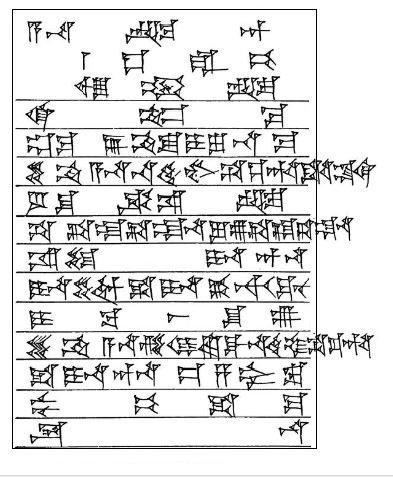
"še-am a-na na-kam-tim ša bīt i
lu Šamaš ša Larsam"
Directions for the supply of Corn for the Temple of the Sun-God
Analisi redazionale, analisi retorico-strutturale e sintesi antropologico-culturale
di Davide Polovineo
April 11-12 2016
1 Analisi redazionale
"Sin-ilu, Bītu-rabi, and Nīḳ-Sin , to whom this letter is addressed, were probably high officials who looked after the collection of revenue in the district of Larsam. That they were something more than revenue-collectors may be inferred from the fact that the king writes to them personally; for the other royal letters in this volume are all addressed to officials of high rank. They are here ordered to hand over certain corn for the temple of the Sun-god, the delivery of which had been delayed" (L.W. KING, Letters and Inscriptions of Ḫammurabi, Vol. III, London, Luzac and Company 1900, p.120).
La House of Plenty del Sun-god di Larsam era un luogo cultuale importante nell'Old babylonian Period ed una fruttuosa impresa privata (private enterprise) della dinastia ḫammurapiana. E' necessario, in tal senso, richiamare un celebre studio di Marc van de Mieroop che presentando il Cultural Background dell'Old babylonian Period afferma: ".....tablets from the [Old Babylonian period] in general derive primarily from private archives, and therefore shed light on various private affairs such as inheritances, debts, marriages, ecc.. Information on the roles of the palace and the temples has to be gleaned from such documents, and the role of these institutions is clearly insufficiently represented. The Idea of the progression in Babylonia from temple dominated to palace dominated economies in the second half of the third millenium and the triumph of private enterprise in the early second millenium, was heavily influenced by the origin of the sources, and has been modified only recently" (M. VAN DE MIEROOP, Society and Enterprise in Old babylonian Ur, BBVO 12, Berlin 1992, 3). L'emergency regulation della private enterprise dell'House of Plenty del Sun God di Larsam è Identity System del grade of civilitation della dinastia ḫammurapiana (cfr.per la terminologia J. ASSMANN, La memoria culturale. Scrittura, ricordo e identità politica nelle grandi civiltà antiche, Torino 1997, p.122). Per questo la fonte Brit. Mus. No. 13, 936; pl. 84, No. 49 (Directions for the supply of corn for the Temple of the Sun-God in the City of Larsam) deve essere analizzata sinotticamente (cfr.le fonti Brit. Mus. No. 23,122 ; pl. 49; No.29; Brit.Mus. No. 23, 148; pl. 66; No.39; PBS 1/2 12 e YOS 2 113).
La formula d'indirizzo (formula a-na) ci permette di delineare un primo livello comparativo con la fonte Brit. Mus. No. 23,159, pl. 75, No.43 ( Directions for the restoration of a patesi to his former position): nella fonte è presente Sin-ilu. L.W. King afferma: "It would appear that the case of the patesi Sin-ilu has already formed the subject of correspondence between Sin-idinnam and the King. We may assume that Taribatum had complained to Ḫammurabi that Sin ilu had been taken from his service and handed over to the rīdūti, and from the present letter we learn that the King had written to Sin-idinnam ordering him to restore Sin-ilu to his former position. Sin-idinnam's reply to his request was to send Sin-ilu to Babylon, while he handed Sin-ilu's sons over to the rīdūti" (L.W. KING, Letters and Inscriptions of Ḫammurabi, p.107). PA-TE-SI (sumerian official title) è presente in Brit. Mus. No. 23,159, pl. 75, No.43 e Brit. Mus. No. 23,147; pl. 64; No.38 (Directions for the transfer of a PA-TE-SI to the service of another official) Brit. Mus. 12, 840, pl. 28, No. 17 (Warrant for the arrest of two governors and a soothsayer who were officials of the Palace Gate) mentre rīdūti (directors of the public slaves) è presente in Brit. Mus. 15, 848, pl. 43, No.26 (Directions concerning the restoration of certain men to their former employers), Brit. Mus. 12, 816, pl. 4, No. 3 , Brit. Mus. 12, 812; pl. 1, No. 1. Da un punto di vista redazionale, il titolo PA-TE-SI, probabilmente, è corrispondente al titolo accadico bitu-rabi [cfr. anche a livello comparativo il titolo bēl bīti accadico e b῾l bt ugaritico= capo famiglia ma anche reggente e/0 governante (CTA I [VI AB]: IV 6; 2 [III AB]: I 17; 6 [1 AB]: VI 57; 15 [III K]: IV 28; PRU V nr. 60,11.13.15.19 [cfr. anche A.SERI, Local Power in Old Babylonian Mesopotamia. Studies in Egyptology and the Ancient Near East, London 2005; cfr. J.C. DE MOOR, ba῾al in GLAT I 1435-1436; H.A. HOFFNER, baît, in GLAT I, 1275 ss; cfr. W.ROBERTSON-SMITH, Kinship and marriage, London 1885 per il Cultural background; cfr. anche A. SJÖBERG, Zu einigen Verwandschaftbezeichnungen im Sumerischen- Heidelberger Studien zum Alten Orient (1967) 201-231)]. E' necessario ricordare che, solitamente e retoricamente, Sa-am-su-iluna utilizzava il titolo bēl (cfr. PBS 1/2 12; PBS 1/2 13): nella nostra fonte il "titolo signorile" è assente.
La fonte Brit. Mus. No. 23,159, pl. 75, No. 43 ci permette di comprendere la delicata situazione che dovette affrontare Sa-am-su-iluna: per questo, la fonte Direction-Letter non è un testo d'immediata comprensione. E' necessario richiamare ancora il commento di King per la compresione dell'attante Sin ilu: "It is probable that Sin-idinnam was assured of the justice of his own case, but the present letter, in which he is reproved for what he has done, makes it clear that Ḫammurabi would not have his orders disobeyed" (L.W. KING, Letters and Inscriptions of Ḫammurabi, p.107). E' chiaro, infatti, che Sa-am-su-iluna conosceva la situazione e nella lettera utilizza la seguente fraseologia: i-na še-im ša i-na ga-ti-ku-n i-ba-aš-šu-u še-am a-na zi-mi ukullī na-kam-tum ša bīt ilu Šamaš ša i-na-na iz-za az-zu ub-bi-ša ma id-na.
Nelle formule idiomatiche delle International royal Direction-Letters, solitamente, la formula henceforth+in your hand è utilizzata per sottolineare l' "Identity System" feudale: ad esempio nella fonte ugaritica CAT 3.5 il testo recita: wa yatana-nni li baʻaluni bini kiliteni wa li wa li banihu ʻadi ʻalami šaḥra ʻalamta bunušu bunušima la yiqqaḥu-nni bidi ba ʻaluni bini kiliteni wa bidi banihu ʻadi ʻalami wa unuṯtu ina bihu (A partire da oggi / ʻAmmiṯtamru, figlio/ di Niqmepaʻ, re/ di Ugarit, ha dato / il terreno di Kušuḫdalu figlio di [ /..../ e li ha dati/ a Baʻalanu figlio/ di Kilitenu e ai / suoi figli, per sempre./ Nel futuro/ nessun uomo/ potrà prenderli dalle mani/ di Baʻalanu figlio di Kilitenu/ o dalle mani dei suoi figli, per sempre. Né tasse feudali/ vi sono in essi). E' interessante anche la fonte RS 16.166: " A partire da oggi/ Niqmaddu, figlio di ʻAmmiṯtamru/ re di Ugarit/ ha confiscato possedimenti e terre/ (poste) in Ullamu/ e le ha donate/ a Nuriyanu, suo fratello/ e ai suoi figli/ per sempre... Nessuno dalle/ mani di Nuriyanu/ o da quelle dei suoi figli/ potrà prenderle".
In tal senso si comprende l'importanza della formula Henceforth+ in your hand nella Direction-Letter di Sa-am-su-iluna che "riconferisce" il titolo di alto ufficiale a Sin-ilu dopo la vicenda ḫammurapiana (la formula henceforth+in your hand riconfigura l'Identity System templare). Per questo motivo, probabilmente, Sa-am-su-iluna scrive personalmente a Sin-ilu e Nīḳ-Sin:
2 Analisi retorico-strutturale: composizione
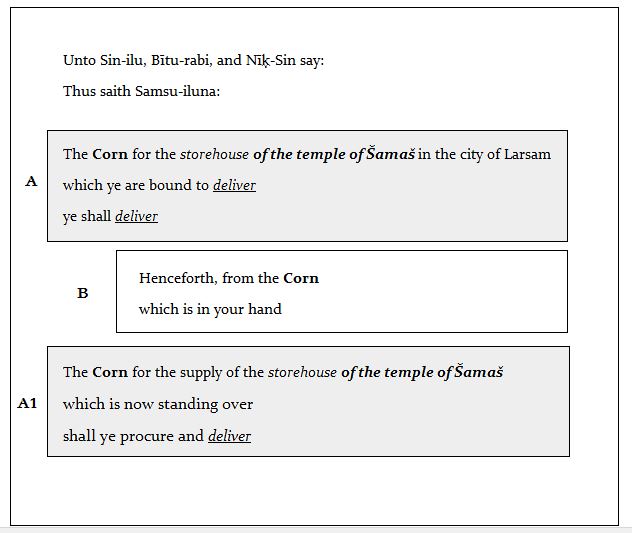
Gli elementi retorico-strutturali sono i seguenti:
še-am a-na na-kam-tim ša bīt ilu Šamaš ša Larsam
bušū Ig-mil- Sin
ša ta-at-ta-ad-na lu-u ta-at-ta-ad-na
iš-tu i-na-an-na
i-na še-im ša i-na ga-ti-ku-nu
še-am a-na zi-mi ukullī na-kam-tum ša bīt ilu Šamaš
ša i-na-na iz-za az-zu
ub-bi-ša ma
id-na
L'intera struttura è sorretta dall'elegante costruzione verbale ta-at-ta-ad-na lu-u ta-at-ta-ad-na (cfr. verbo nadanu I) e dalla raffinata costruzione verbale con id-na (in questo caso per id-na cfr. sempre verbo nadanu III). Per la composizione seguiamo la traduzioni di King: